
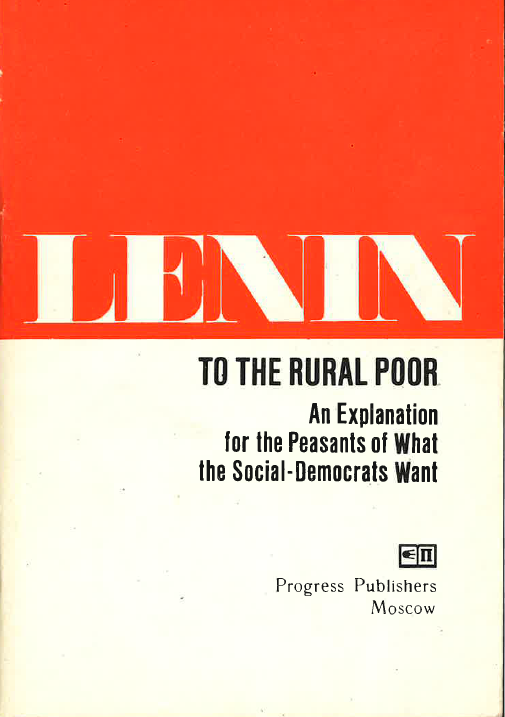
Written in 1903 and smuggled illegally across the Russian Empire to reach peasants in scores of towns and villages, To the Rural Poor stands as one of Lenin’s most remarkable works of political agitation. Published in Geneva in May 1903 by the League of Russian Revolutionary Social-Democracy Abroad, the pamphlet set out Lenin’s Marxist analysis of class divisions within the countryside, distinguishing landlords, the peasant bourgeoisie, middle peasants, and rural semi-proletarians. It was distributed to over 75 towns and villages in the two years following its publication alone. It appeared alongside the draft programme of the Russian Social Democratic Labour Party, which would be adopted at the historic Second Congress only months later, the congress that gave birth to Bolshevism as a distinct political tendency. What distinguishes this pamphlet is not only its theoretical precision but the deliberate simplicity of its language: Lenin wrote for the rural poor themselves, addressing their conditions directly and without condescension, in order to win them to the programme of the working class.
Lenin’s core argument is the necessity of an alliance between the working class and the rural poor organised on a socialist program. Lenin systematically dismantles the illusions promoted by the Narodniks and other false friends of the peasantry, who were promising land reform through the existing state. The pamphlet demonstrates, by the logic of political economy, why land “redistribution” within the framework of capitalist property relations reproduces inequality. Under capitalism land and agriculture are subordinated to money and markets, and so the poor are systematically excluded unless the social order itself is transformed. Against this, Lenin counterposes the demand for the revolutionary overthrow of the autocracy, the convening of a genuine popular assembly, and the alliance of the rural poor with the urban proletariat organised in a conscious socialist party, the only force capable of fighting not just individual landlords but the entire bourgeois order.
The pamphlet retains full relevance today, a century after the Russian Revolution and in a period of deepening capitalist crisis on a world scale. Across the globe, rural and agricultural workers face dispossession, indebtedness, and immiseration driven by the same fundamental logic of capital accumulation that Lenin analysed in Tsarist Russia. The pseudo-left organisations that dominate much of the official left continue to promote variants of the same reformist politics Lenin combated, placing faith in regulatory bodies, progressive governments, and gradual land redistribution rather than the independent political mobilisation of the working class. For workers and youth seeking to understand why genuine emancipation requires a break with all such programmes, and why the unity of the urban and rural poor on a socialist basis remains a central strategic question, Lenin’s pamphlet is an indispensable starting point.
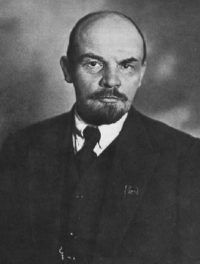 Vladimir Lenin (1870-1924) was the founder and leader of the Bolshevik Party and a central figure within the Marxist movement from the end of the 19th century until his death in 1924. In October 1917 he, along with Leon Trotsky, led the Russian Revolution that brought the Bolsheviks to power and established the first workers’ state.