
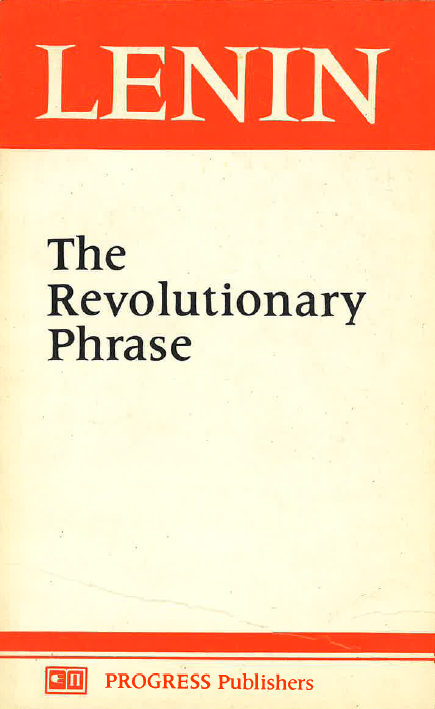
Written in February 1918 Lenin’s, “The Revolutionary Phrase”, was produced at a moment when the Bolshevik leadership was bitterly divided over whether to sign the humiliating peace terms being imposed at Brest-Litovsk. A significant faction, centred on Bukharin’s Left Communists, was calling for a revolutionary war against German imperialism. Lenin’s target in this pamphlet was the political dangerous tendency to substitute emotionally satisfying revolutionary-sounding slogans for a rigorous assessment of objective reality. Against the call for revolutionary war, Lenin asks the most basic questions: where is the army? Where are the regiments being formed, the fortifications being built, the concrete acts that would give content to the phrase? The slogan, he demonstrates, contains nothing but sentiment, indignation and wishful thinking. Lenin warns that a leadership that mistakes such sentiment for revolutionary policy will lead the working class to catastrophe.
The historical significance of this book extends far beyond its immediate occasion. Lenin’s attitude is of profound importance, an assessment of what is objectively possible at a given historical moment cannot be replaced by what one desires to be possible. Lenin’s strength in the fateful days of war and peace was his strictly uncompromising adherence to principles, combined with his readiness to adapt his tactics to the changing objective circumstances. When the German offensive vindicated his position and the peace was eventually signed, Trotsky acknowledged at a session of the Central Executive Committee that Lenin had maintained, with “amazing foresight” and against opposition, that the peace was necessary to tide the revolution over until the world proletarian revolution matured.
Today, in an era of renewed imperialist war, the pressure on socialist and anti-war tendencies to adopt hollow, posturing positions has never been greater. The organisations of the pseudo-left, from Socialist Alternative in Australia to their international co-thinkers, habitually substitute radical-sounding denunciations for any serious analysis of class forces or the concrete tasks before the working class. Lenin’s warnings of “revolutionary phrase-making” applies with full force here. It describes “the repetition of revolutionary slogans irrespective of objective circumstances at a given turn invents”, disconnected from objective reality, and therefore serves to disorient rather than mobilise the working class..
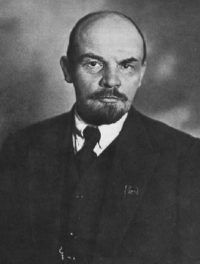 Vladimir Lenin (1870-1924) was the founder and leader of the Bolshevik Party and a central figure within the Marxist movement from the end of the 19th century until his death in 1924. In October 1917 he, along with Leon Trotsky, led the Russian Revolution that brought the Bolsheviks to power and established the first workers’ state.