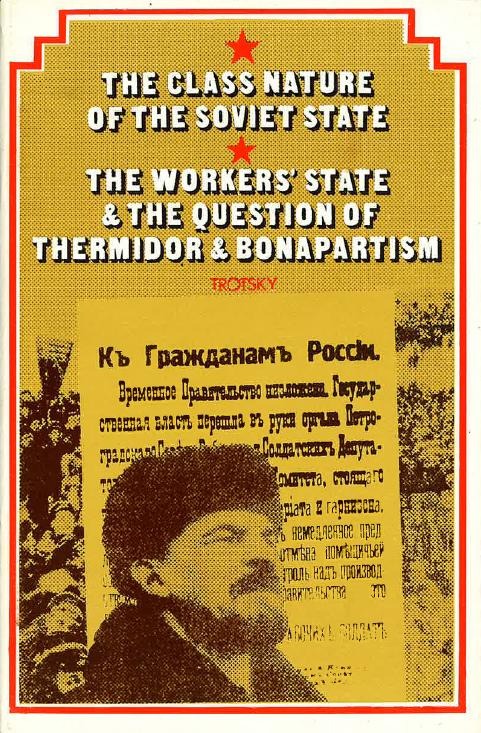
These two essays, constitute the theoretical foundation of the Fourth International’s analysis of the Soviet Union and, more broadly, the Marxist method for characterising degenerated and deformed workers’ states.
In The Class Nature of the Soviet State (1933), Trotsky confronted the increasingly urgent question posed by Stalinist rule: had the bureaucratic degeneration of the USSR already transformed it into a new form of class society? Against both ultra-left currents that declared the Soviet state already capitalist or “bureaucratic collectivist,” and the reformist and Stalinist apologists who saw in the bureaucracy a legitimate continuation of the workers’ state, Trotsky’s answer was unambiguous: despite the degeneration of the political superstructure under the Stalinist bureaucracy, the Soviet Union remained a workers’ state – albeit a deeply degenerated one – because its economic foundations, the nationalisation of the means of production and the abolition of private capitalist property, had not been overturned. The character of a state, Trotsky insisted, cannot be determined by the sociology of its ruling stratum alone but must be grounded in the property relations it defends.
In The Workers’ State and the Question of Thermidor and Bonapartism (1935), Trotsky extended and deepened this analysis through a penetrating historical analogy. Drawing on the experience of the French Revolution – specifically the Thermidorean reaction of 1794 and the subsequent rise of Bonapartism – he examined whether the Stalinist regime represented a Thermidor within the revolution, or had already transcended it into an outright Bonapartist deformation. The essay is a masterclass in the Marxist use of historical analogy: not the mechanical application of past experience to present conditions, but the identification of structural similarities and differences that illuminate the dynamics of a living political process.
Together, these works demonstrate why the question of the Soviet state was not a scholastic matter but one of acute practical consequence. Whether the USSR remained – however degenerated – a conquest of the October Revolution, or had been transformed into a new exploitative class society, determined the entire strategic and programmatic orientation of the revolutionary movement against Stalinism: political revolution to restore workers’ power over the state they had created in the 1917 Russian Revolution against the Stalinist bureaucratic caste, the gravedigger of the revolution.
48 pages
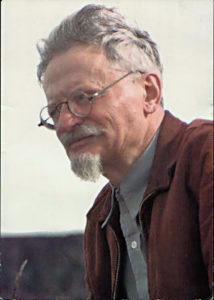 Leon Trotsky (1879-1940) was born on November 7, 1879 in the village of Yanovka, which at the time was part of the Russian Empire and is now within the borders of Ukraine. Along with Vladimir Lenin, he was one of the leaders of the October Revolution of 1917, which brought the Bolsheviks to power in Russia. Trotsky, who was head of the Red Army during the years immediately following the revolution, led the Soviet Union to victory in the Civil War from 1918-1921.
Trotsky founded the Left Opposition in 1923, which was established to oppose the growth of bureaucratism, nationalism, and inequality in the Soviet Union under Stalin’s leadership. He was an outspoken defender of the perspective of internationalism against the program of “socialism in one country”, which the Stalinist bureaucracy advanced as part of the defense of its own power and privileges.
Because of his intransigent opposition to Stalinism, he was expelled from the Communist Party in 1927, sent into exile in Central Asia in 1928, and ultimately banished from the Soviet Union in 1929. In 1933, Trotsky warned that the policies pursued by the Stalinist Communist Party in Germany, if not changed, would pave the way for the coming to power of Hitler by politically disorienting and organizationally disarming the working class in the face of the fascist threat. After his warnings were proven correct, Trotsky concluded that Stalin’s betrayal of the German working class meant that the Third International could not be reformed. In 1938, he founded the Fourth International. Trotsky was murdered in 1940 in Mexico, where he had been given asylum, by a Stalinist agent.
In addition to his political work, Trotsky was a major Marxist theoretician. He elaborated the theory of “permanent revolution”, which explained why an economically backward country like Russia was driven onto the path of socialist revolution despite the fact that it had a comparatively low level of capitalist development. Trotsky’s theory ultimately formed the basis for the October 1917 revolution.
His letters and articles explaining the class nature of the Soviet state, written in the context of an inner-party debate that took place in 1939-1940 within the Trotskyist movement and collected in the volume In Defense of Marxism, are a brilliant example of the application of the dialectical materialist method to the analysis of contemporary political questions and problems of party program and perspective.
Trotsky’s prediction, outlined most explicitly in The Revolution Betrayed, that unless the working class in the USSR regained power through a political revolution, the Stalinist bureaucracy would bring about the restoration of capitalism, was proven correct by the events of 1989-1991.
Additional information about Trotsky’s political biography, his role in Soviet and world history, and his treatment at the hands of modern historians can be found here: Leon Trotsky, Soviet Historiography, and the Fate of Classical Marxism
Books by Leon Trotsky