Lenin’s “On Peaceful Coexistence” brings together his articles, speeches, and diplomatic notes from the period following the October Revolution, when Soviet Russia was compelled to define its relations with the surrounding capitalist powers. Emerging from the Decree on Peace of 1917 and running through the years of civil war, foreign intervention, and the Genoa Conference, these writings document how the young workers’ state sought trade agreements, negotiated with figures such as Vanderlip and Bullitt, and pursued diplomatic and economic relations with imperialist governments, not as a renunciation of revolutionary internationalism, but as a tactical necessity for an isolated Soviet republic surviving amid hostile capitalist encirclement.
The book is of enormous historical and political significance precisely because it allows readers to test Lenin’s actual positions against the doctrine that later came to bear a similar name. Under Stalin and his successors, “peaceful coexistence” was transformed into a strategic and ideological framework – an expression in the realm of foreign policy of the theory of “Socialism in One Country” – which justified the subordination of world revolution to great-power diplomacy and the defense of the bureaucracy’s national interests. Lenin’s writings, read in their historical context, show a leadership maneuvering tactically on the diplomatic and economic terrain while never abandoning the perspective of international socialist revolution, a distinction of fundamental importance for understanding the political degeneration that Stalinism represented.
For workers, students, and socialists today, this collection offers essential material for grasping how a revolutionary government navigates the relationship between state necessity and international principle. At a time when the language of “peaceful coexistence” and “multipolarity” is once again used to dress up great-power maneuvering and nationalist reaction in progressive terms, Lenin’s own writings provide a rigorous historical and theoretical standard against which such claims can be measured. Mehring Books is making this volume available as a contribution to the political and historical education of a new generation.
Pages: 143
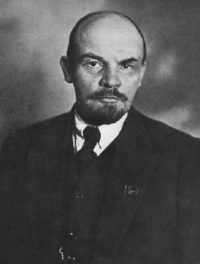 Vladimir Lenin (1870-1924) was the founder and leader of the Bolshevik Party and a central figure within the Marxist movement from the end of the 19th century until his death in 1924. In October 1917 he, along with Leon Trotsky, led the Russian Revolution that brought the Bolsheviks to power and established the first workers’ state.
In 1902 Lenin published What is to be Done?, a major theoretical work which critiqued the trade unionist perspective that sought to limit the struggles of workers to economic questions. He insisted on the necessity of a political solution to capitalist exploitation and outlined a theory of the revolutionary party as the vanguard of the working class.
Lenin led the split with the Mensheviks in the Russian Social Democratic Party in 1903, maintaining that the forthcoming revolution in Russia could not be of a solely bourgeois-democratic character. Over the course of the next 14 years he fought a long struggle against Menshevism. This ultimately culminated in his issuing in April 1917 of a set of political theses that unequivocally called for a proletarian socialist revolution in Russia.
Lenin was an ardent defender of internationalism. In 1914, when the German Social Democratic Party, the leading section of the Second International, abandoned Marxism by supporting German imperialism in World War I, Lenin fought against this national chauvinist perspective. In defense of the outlook of world revolution, he advocated the founding of the Third International. His Imperialism, published in 1917, identified the origins of the bloodbath engulfing Europe at the time in the inner workings of capitalism.
Lenin made major contributions to the development of Marxist philosophy, leaving behind a voluminous body of writings. Materialism and Empirio-Criticism was his defense of dialectical materialism and a withering critique of efforts by figures with ties to the Bolshevik Party to substitute idealist forms of thinking for materialist philosophy.
Lenin died in January 1924 after a series of strokes, which had left him incapacitated for many months prior. In his Last Testament, suppressed for many years by the rising Soviet bureaucracy, he called for the removal of Joseph Stalin from his post as General Secretary of the Communist Party of the Soviet Union.