
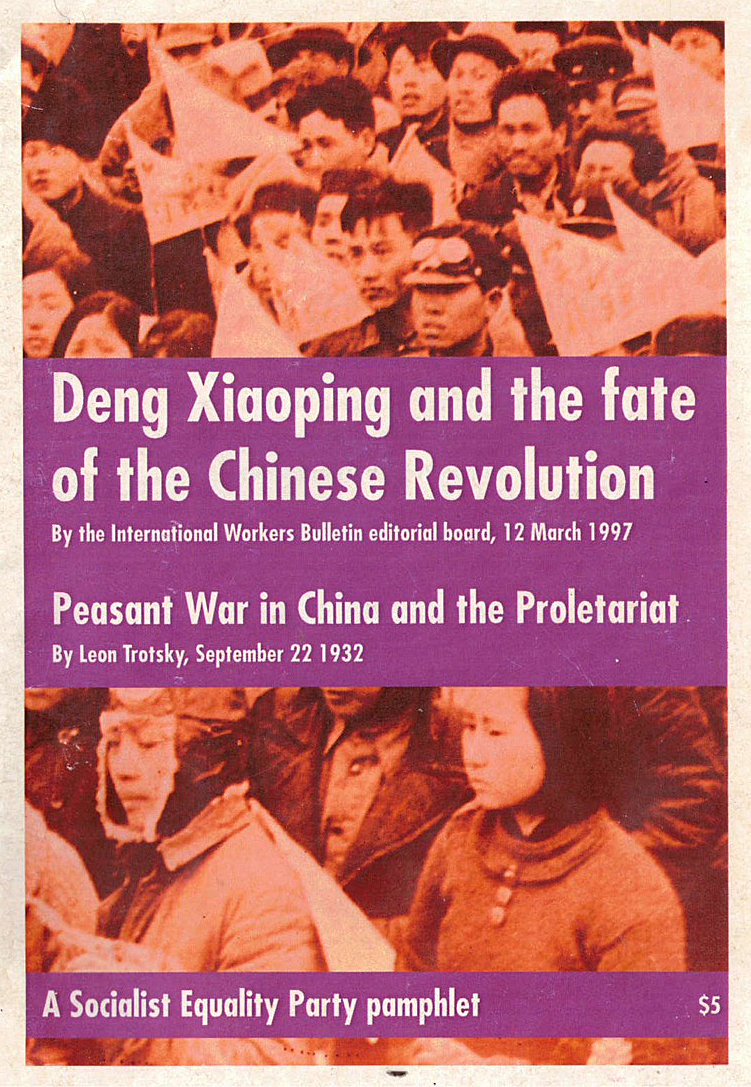
The betrayal and defeat of the Chinese Revolution of 1925–27 stands as one of the most consequential political crimes of the twentieth century. On the orders of the Stalinist Comintern, the Communist Party of China subordinated the working class to the bourgeois nationalist Guomindang, disarmed the revolutionary movement, suppressed every independent workers’ initiative and opened the door to Chiang Kai-shek’s massacre of tens of thousands of workers and communists. The political lessons of that catastrophe were drawn out by Trotsky and the Left Opposition as a confirmation in the negative of the theory of Permanent revolution: the Chinese bourgeoisie was organically incapable of leading a genuine national liberation. Only the working class on the basis of an internationalist perspective, drawing the peasantry behind it, could provide a progressive solution to the problems of the Chinese revolution. Trotsky’s 1932 letter on the peasant war in China, included in this pamphlet, sharpens that analysis further. Essentially, a peasant army separated from the proletariat, however Communist in name, carries within it the seeds of a new counter-revolution.
The 1949 revolution and the trajectory of the deformed workers state that emerged from the 1949 revolution cannot be understood apart from this history. Deng Xaioping’s “reforms”, the restoration of capitalist relations, the revival of imperialist concessions in the form of special economic zones, the subordination of the Chinese working class under the banner of “socialism with Chinese characteristics” was not a departure from Maoism but its logical conclusion. Both rested on the same Stalinist foundations that produced the 1927 disaster: the nationalist rejection of permanent revolution, the subordination of the independence of the working class to bourgeois or bureaucratic interests, and contempt for Marxist internationalism. This pamphlet traces that continuity, from the Shanghai massacre to the massacre at Tiananmen Square in 1989, where workers and youth were cut down as they sang the Internationale.
Today, as China stands at the centre of an accelerating inter-imperialist confrontation, the revolutionary lessons fought out across the 20th century are not historical curiosities but live strategic questions. The fate of the Chinese and international working class depends on a movement that has assimilated these fundamental lessons. This pamphlet provides that foundation.
The volume also contains Trotsky’s essay on “The Peasant War in China and the Proletariat”
Pages 34