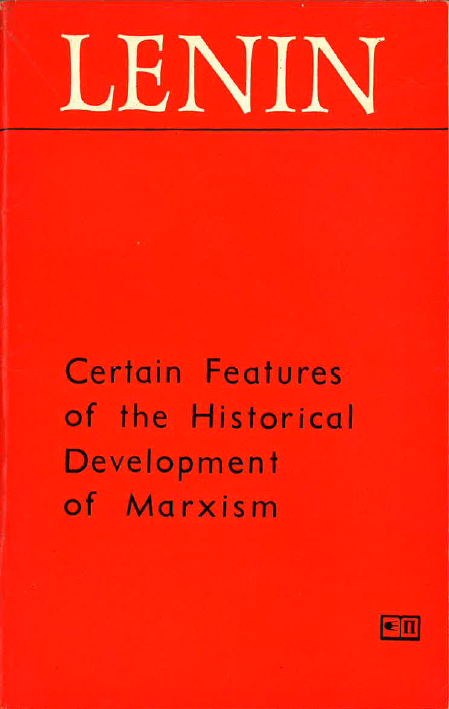
Written by Lenin in 1910, “Certain Features of the Historical Development of Marxism” is an incisive essay on how Marxism advances as a living body of theory rather than a fixed doctrine. Lenin argues that Marxism develops dialectically, through the struggle against distortions from opportunism, which dilutes revolutionary theory to accommodate it to existing conditions and bourgeois respectability, and “empty phrase-mongering”, which ossifies theory into rigid formulas and slogans learnt by heart but not understood, divorced from the real movement of the working class. The essay is a defence of Marxism as a method for grasping concrete historical development.
Drawing on the experience of the Russian workers’ movement in the years surrounding the 1905 revolution, Lenin shows how both tendencies – the liquidationism of the right and the otzovism of the ultra-left, which demanded the recall of Social-Democratic deputies from the Duma on the ground that parliamentary work had become beneath revolutionary dignity – represent departures from genuine Marxism, arising from the same failure to analyse changing class relations concretely. His treatment of these tendencies as two sides of the same problem equips readers to recognise the recurring forms in which political retreat and empty radicalism reappear in every period of the workers’ movement.
For readers today, the essay’s relevance extends well beyond its immediate historical occasion. Lenin’s argument, that revolutionary theory must be defended against both liquidation into renunciation and calcification into dogma, speaks directly to recurring debates on the left over the relationship between theory and practice, principle and tactics. It is essential reading for anyone seeking to understand Lenin’s conception of Marxism as a science of society requiring constant renewal through concrete analysis, rather than a set of ready-made answers.
Pages: 75
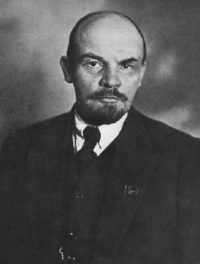 Vladimir Lenin (1870-1924) was the founder and leader of the Bolshevik Party and a central figure within the Marxist movement from the end of the 19th century until his death in 1924. In October 1917 he, along with Leon Trotsky, led the Russian Revolution that brought the Bolsheviks to power and established the first workers’ state.
In 1902 Lenin published What is to be Done?, a major theoretical work which critiqued the trade unionist perspective that sought to limit the struggles of workers to economic questions. He insisted on the necessity of a political solution to capitalist exploitation and outlined a theory of the revolutionary party as the vanguard of the working class.
Lenin led the split with the Mensheviks in the Russian Social Democratic Party in 1903, maintaining that the forthcoming revolution in Russia could not be of a solely bourgeois-democratic character. Over the course of the next 14 years he fought a long struggle against Menshevism. This ultimately culminated in his issuing in April 1917 of a set of political theses that unequivocally called for a proletarian socialist revolution in Russia.
Lenin was an ardent defender of internationalism. In 1914, when the German Social Democratic Party, the leading section of the Second International, abandoned Marxism by supporting German imperialism in World War I, Lenin fought against this national chauvinist perspective. In defense of the outlook of world revolution, he advocated the founding of the Third International. His Imperialism, published in 1917, identified the origins of the bloodbath engulfing Europe at the time in the inner workings of capitalism.
Lenin made major contributions to the development of Marxist philosophy, leaving behind a voluminous body of writings. Materialism and Empirio-Criticism was his defense of dialectical materialism and a withering critique of efforts by figures with ties to the Bolshevik Party to substitute idealist forms of thinking for materialist philosophy.
Lenin died in January 1924 after a series of strokes, which had left him incapacitated for many months prior. In his Last Testament, suppressed for many years by the rising Soviet bureaucracy, he called for the removal of Joseph Stalin from his post as General Secretary of the Communist Party of the Soviet Union.