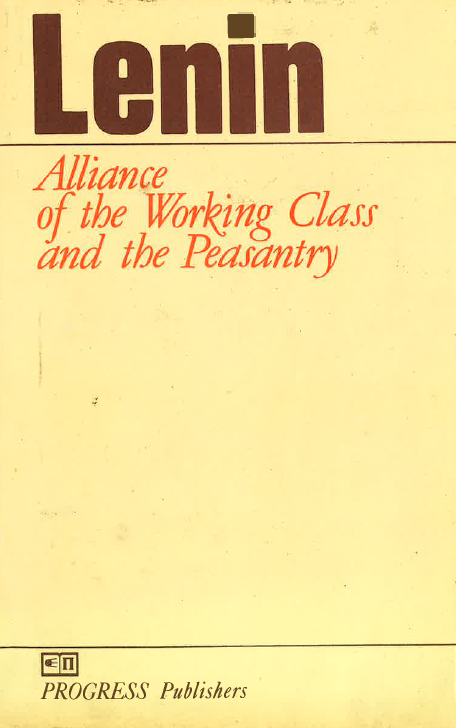
This volume gathers Lenin’s articles and speeches on the revolutionary movement’s policy toward the peasantry, tracing how the task of building a durable alliance between workers and the rural poor was confronted and resolved across nearly a quarter century of momentous historical struggle. For workers and young people today, it offers a concrete record of how Marxist politics actually operates in conditions where the working class is a minority and must win other oppressed layers to its side. Lenin’s writings here are hard-won lessons drawn from the crucible of 1905, the February and October revolutions, the Civil War, and the first years of the Soviet Union.
The political questions Lenin confronts have not aged. In the twenty-first century, the working class faces conditions in which it must win the support of vast layers of the population to its side. Lenin shows unflinching honesty about the contradictions and limitations of the worker-peasant alliance, its potential vacillations under pressure, its dependence on the political clarity and independence of the working class, while insisting that without winning this alliance, socialist revolution remains impossible.
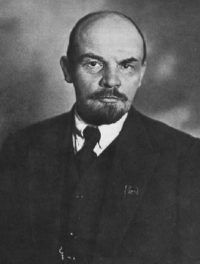 Vladimir Lenin (1870-1924) was the founder and leader of the Bolshevik Party and a central figure within the Marxist movement from the end of the 19th century until his death in 1924. In October 1917 he, along with Leon Trotsky, led the Russian Revolution that brought the Bolsheviks to power and established the first workers’ state.
In 1902 Lenin published What is to be Done?, a major theoretical work which critiqued the trade unionist perspective that sought to limit the struggles of workers to economic questions. He insisted on the necessity of a political solution to capitalist exploitation and outlined a theory of the revolutionary party as the vanguard of the working class.
Lenin led the split with the Mensheviks in the Russian Social Democratic Party in 1903, maintaining that the forthcoming revolution in Russia could not be of a solely bourgeois-democratic character. Over the course of the next 14 years he fought a long struggle against Menshevism. This ultimately culminated in his issuing in April 1917 of a set of political theses that unequivocally called for a proletarian socialist revolution in Russia.
Lenin was an ardent defender of internationalism. In 1914, when the German Social Democratic Party, the leading section of the Second International, abandoned Marxism by supporting German imperialism in World War I, Lenin fought against this national chauvinist perspective. In defense of the outlook of world revolution, he advocated the founding of the Third International. His Imperialism, published in 1917, identified the origins of the bloodbath engulfing Europe at the time in the inner workings of capitalism.
Lenin made major contributions to the development of Marxist philosophy, leaving behind a voluminous body of writings. Materialism and Empirio-Criticism was his defense of dialectical materialism and a withering critique of efforts by figures with ties to the Bolshevik Party to substitute idealist forms of thinking for materialist philosophy.
Lenin died in January 1924 after a series of strokes, which had left him incapacitated for many months prior. In his Last Testament, suppressed for many years by the rising Soviet bureaucracy, he called for the removal of Joseph Stalin from his post as General Secretary of the Communist Party of the Soviet Union.