Against Revisionism, In Defence of Marxism collects eighteen of Lenin’s writings from 1899 to 1921, documenting his sustained struggle against the revisionist currents that sought to hollow out Marxism from within the socialist movement. From his early critique of “Economism” through the landmark 1908 essay “Marxism and Revisionism” to his wartime polemics against the collapse of the Second International, Lenin insists that Marxism survives as a revolutionary theory only through the relentless theoretical struggle against those who soften or abandon its principles while still invoking its name.
Central to the collection is Lenin’s argument that revisionism is not an honest disagreement but the systematic adaptation of Marxist theory to the interests of the labour bureaucracy and the pressures of bourgeois society. In essays like “Opportunism and the Collapse of the Second International” and “Imperialism and the Split in Socialism,” he traces opportunism to the material privileges of a labour aristocracy under imperialism, showing revisionism is a political expression of definite social interests within the workers’ movement.
For Lenin, the fight against revisionism was inseparable from building a revolutionary party capable of leading the working class to power. His 1921 report to the Tenth Congress on the “Anarcho-Syndicalist Deviation” shows this struggle continuing even after the October Revolution, underlining his view that vigilance against opportunism is a permanent task of revolutionary politics, never a battle finally won.
The volume remains essential reading because the phenomenon it dissects, the erosion of socialist politics through accommodation to existing institutions and nationalism, did not end with Lenin’s era. Studying these writings equips readers to recognise revisionism in its contemporary forms and to grasp why Lenin saw the theoretical defence of Marxism as inseparable from the fight for socialism itself.
Pages: 168
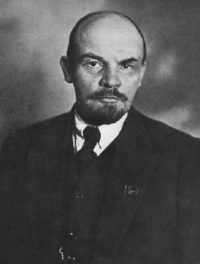 Vladimir Lenin (1870-1924) was the founder and leader of the Bolshevik Party and a central figure within the Marxist movement from the end of the 19th century until his death in 1924. In October 1917 he, along with Leon Trotsky, led the Russian Revolution that brought the Bolsheviks to power and established the first workers’ state.
In 1902 Lenin published What is to be Done?, a major theoretical work which critiqued the trade unionist perspective that sought to limit the struggles of workers to economic questions. He insisted on the necessity of a political solution to capitalist exploitation and outlined a theory of the revolutionary party as the vanguard of the working class.
Lenin led the split with the Mensheviks in the Russian Social Democratic Party in 1903, maintaining that the forthcoming revolution in Russia could not be of a solely bourgeois-democratic character. Over the course of the next 14 years he fought a long struggle against Menshevism. This ultimately culminated in his issuing in April 1917 of a set of political theses that unequivocally called for a proletarian socialist revolution in Russia.
Lenin was an ardent defender of internationalism. In 1914, when the German Social Democratic Party, the leading section of the Second International, abandoned Marxism by supporting German imperialism in World War I, Lenin fought against this national chauvinist perspective. In defense of the outlook of world revolution, he advocated the founding of the Third International. His Imperialism, published in 1917, identified the origins of the bloodbath engulfing Europe at the time in the inner workings of capitalism.
Lenin made major contributions to the development of Marxist philosophy, leaving behind a voluminous body of writings. Materialism and Empirio-Criticism was his defense of dialectical materialism and a withering critique of efforts by figures with ties to the Bolshevik Party to substitute idealist forms of thinking for materialist philosophy.
Lenin died in January 1924 after a series of strokes, which had left him incapacitated for many months prior. In his Last Testament, suppressed for many years by the rising Soviet bureaucracy, he called for the removal of Joseph Stalin from his post as General Secretary of the Communist Party of the Soviet Union.