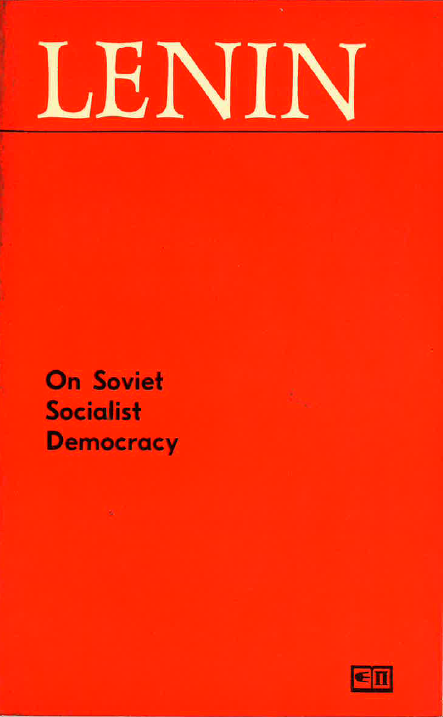
Lenin’s “On Soviet Socialist Democracy” assembles his key writings on the theory and practice of the form of government created by the Russian working class in 1917, the only time in history that the exploited majority has taken power into its own hands and begun to run society itself.
The book opens with material on the national question before turning to its theoretical foundation on the withering away of the state, which traces Marx’s account of the transition from capitalism through the first and higher phases of communist society. This is the heart of the matter. Lenin shows that the state is not a neutral arbiter standing above society but a machine for the rule of one class over another and that the working class cannot simply take hold of the existing state apparatus. It must be smashed and replaced by organs of workers’ power. From this theoretical starting point the volume moves into the actual record of 1917–1919: addresses to the population, the right of recall of elected deputies, the Declaration of Rights of the Working and Exploited People, and reports to the All-Russia Congress of Soviets, documenting how the new soviet state was constituted and defended in its first years.
At the centre of the collection is Lenin’s sustained polemic against the counterposing of “pure” democracy to soviet power, on bourgeois versus proletarian democracy, whether equality can exist between exploiter and exploited, and why the soviets could not remain adjuncts to a bourgeois state. Lenin’s target was Karl Kautsky, the leading theorist of the Second International who, faced with a real workers’ revolution, chose the “purity” of bourgeois parliamentarianism over the actual power of the working class. The book’s central argument is that soviet democracy was not a departure from democratic principle but its extension to the working class and the oppressed masses.
The later selections of the book shows Lenin grappling with the practical questions of governing: labour discipline, women’s emancipation, the courts, education, and how revolutionaries should relate to existing mass organisations. This collection shows that soviet democracy was a set of institutions and struggles that had to be built, defended and continually developed.
Pages: 223
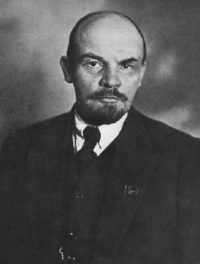 Vladimir Lenin (1870-1924) was the founder and leader of the Bolshevik Party and a central figure within the Marxist movement from the end of the 19th century until his death in 1924. In October 1917 he, along with Leon Trotsky, led the Russian Revolution that brought the Bolsheviks to power and established the first workers’ state.
In 1902 Lenin published What is to be Done?, a major theoretical work which critiqued the trade unionist perspective that sought to limit the struggles of workers to economic questions. He insisted on the necessity of a political solution to capitalist exploitation and outlined a theory of the revolutionary party as the vanguard of the working class.
Lenin led the split with the Mensheviks in the Russian Social Democratic Party in 1903, maintaining that the forthcoming revolution in Russia could not be of a solely bourgeois-democratic character. Over the course of the next 14 years he fought a long struggle against Menshevism. This ultimately culminated in his issuing in April 1917 of a set of political theses that unequivocally called for a proletarian socialist revolution in Russia.
Lenin was an ardent defender of internationalism. In 1914, when the German Social Democratic Party, the leading section of the Second International, abandoned Marxism by supporting German imperialism in World War I, Lenin fought against this national chauvinist perspective. In defense of the outlook of world revolution, he advocated the founding of the Third International. His Imperialism, published in 1917, identified the origins of the bloodbath engulfing Europe at the time in the inner workings of capitalism.
Lenin made major contributions to the development of Marxist philosophy, leaving behind a voluminous body of writings. Materialism and Empirio-Criticism was his defense of dialectical materialism and a withering critique of efforts by figures with ties to the Bolshevik Party to substitute idealist forms of thinking for materialist philosophy.
Lenin died in January 1924 after a series of strokes, which had left him incapacitated for many months prior. In his Last Testament, suppressed for many years by the rising Soviet bureaucracy, he called for the removal of Joseph Stalin from his post as General Secretary of the Communist Party of the Soviet Union.