
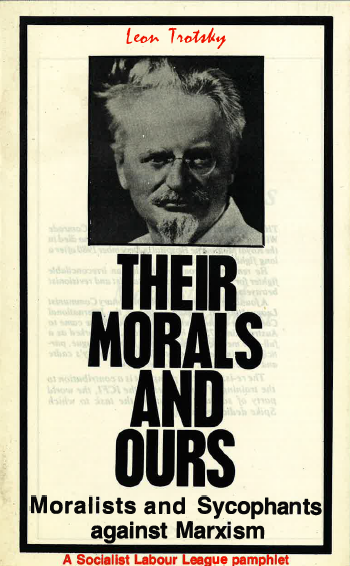
This pamphlet, written by Trotsky in 1938, stands as one of the most powerful and enduring works of Marxist philosophy. It is a systematic demolition of bourgeois morality and a rigorous defence of the materialist foundations of socialist ethics.
The immediate context of its writing was the Stalinist frame-up trials of 1936–38, in which Trotsky and the entire generation of Old Bolsheviks were accused, through forced confessions and outright fabrication, of every conceivable crime. The international liberal intelligentsia, disoriented by the Popular Front and unwilling to break with Moscow, either accepted these slanders or retreated into a cynical “plague on both your houses” moralising, directing equal fire at the accused revolutionaries and their GPU persecutors. Trotsky’s response was to go to the root: what is the actual basis of morality?
Against the idealist claim that moral norms are eternal, divinely ordained, or rooted in abstract “human nature,” Trotsky demonstrates that all moral codes arise from definite social relations and serve definite class interests. The morality of the ruling class, whether dressed in the language of religion, liberal democracy, or Stalinist “socialist patriotism”, is at its core an instrument of class domination. It is not the proletariat which introduces “amoralism” into politics; it is the bourgeoisie which systematically deploys moral language to obscure exploitation, justify imperialist slaughter, and criminalise resistance.
Central to the pamphlet is Trotsky’s critique of the argument that “the end justifies the means”, an argument falsely attributed to Marxism by its opponents. Trotsky turns the question on its head: which ends, and whose? A revolutionary movement that employs methods which corrupt or destroy the class it claims to serve defeats itself. The relationship between means and ends is not arbitrary but dialectical: the means must be adequate to the actual historical goal of human emancipation, which requires the conscious self-activity of the working class. Deception, bureaucratic manipulation, and individual terror – the methods of Stalinism – are not merely tactically wrong but represent a fundamental political degeneration, because they substitute an apparatus for the class.
The questions Trotsky raises in this short but dense work are not of merely historical interest. Marxism is still accused of subordinating human beings to abstract historical forces, of licensing atrocity in the name of utopian ends, of producing only terror and totalitarianism.
In this environment, Their Morals and Ours equips the reader to understand where these attacks actually come from, what class interests they serve, and answering them by placing bourgeois morality itself under the historical microscope. As imperialist wars are justified with the language of human rights, as the crimes of capitalism are obscured behind appeals to “democratic values,” and as pseudo-left tendencies abandon the working class while wrapping themselves in moralistic denunciations, Trotsky’s analysis is as sharp and as necessary as when it was written.
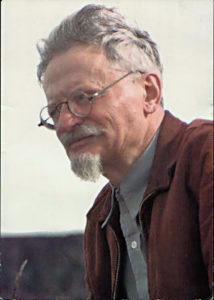 Leon Trotsky (1879-1940) was born on November 7, 1879 in the village of Yanovka, which at the time was part of the Russian Empire and is now within the borders of Ukraine. Along with Vladimir Lenin, he was one of the leaders of the October Revolution of 1917, which brought the Bolsheviks to power in Russia. Trotsky, who was head of the Red Army during the years immediately following the revolution, led the Soviet Union to victory in the Civil War from 1918-1921.