
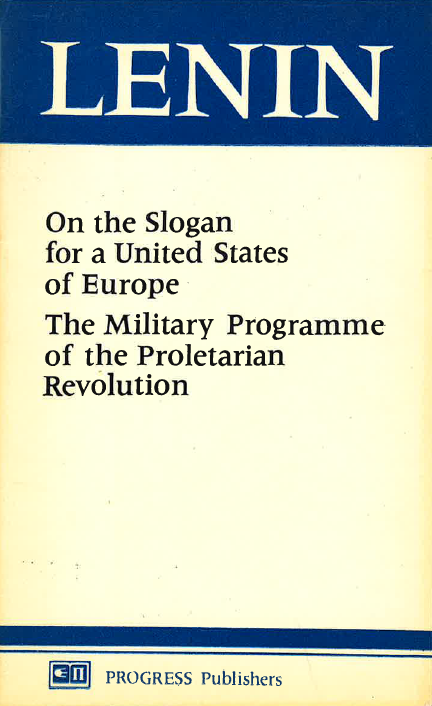
Written in the crucible of the First World War, this pamphlet represents some of Lenin’s most concentrated and far-sighted thinking on imperialism, war, and the strategic tasks of the international working class. Published in Sotsial-Demokrat in August 1915, “On the Slogan for a United States of Europe” was Lenin’s intervention into a debate that had divided the international socialist movement: whether to advance the demand for a federated capitalist Europe as a progressive or transitional goal. Lenin’s answer was an unequivocal refusal of the liberal-pacifist position. A United States of Europe under capitalism, he argued, was either economically impossible, presupposing a planned world economy, or reactionary, signifying a temporary alliance of the Great Powers to enhance their joint oppression of colonies and plunder of more rapidly developing nations. Lenin says, “A United States of Europe under capitalism is tantamount to an agreement on the partition of colonies. Under capitalism, however, no other basis and no other principle of division are possible except force…” Of course, he says, “temporary agreements are possible between capitalists and between states. In this sense a United States of Europe is possible as an agreement between the European capitalists … but to what end? Only for the purpose of jointly suppressing socialism in Europe, of jointly protecting colonial booty against Japan and America, who have been badly done out of their share by the present partition of colonies…”
“The Military Programme of the Proletarian Revolution,” written in September 1916, extended this analysis into a systematic demolition of the “disarmament” slogan advanced by centrists and pacifists, counterposing to it the concrete military and political tasks of a class preparing not to abolish war by pious wishes but to end it through the revolutionary conquest of power. Lenin defends the right of oppressed nations to fight to overthrow imperialist oppression. “Only after we have overthrown, finally vanquished and expropriated the bourgeoisie of the whole world, and not merely in one country, will wars become impossible”… “Socialists cannot”, he says, “without ceasing to be socialists, be opposed to all war”.
Over a century later, this pamphlet speaks with urgent directness to the present situation. As the major imperialist powers again wage war across multiple theatres, as calls for “European defence autonomy” and great-power military blocs multiply, and as social-democratic and pseudo-left organisations abandon socialist internationalism for the logic of “democratic” imperialism, Lenin’s arguments cut through the political fog with undiminished force. Lenin’s insistence that the whole of social life was being militarised. That imperialism as a fierce struggle of the Great Powers for the division and redivision of the world was bound to lead to further militarisation in all countries. For workers and young people seeking to understand the driving forces behind today’s wars and the political betrayals that accompany them, this pamphlet is indispensable.
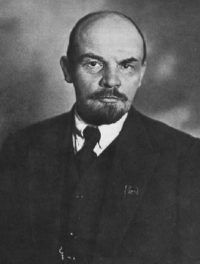 Vladimir Lenin (1870-1924) was the founder and leader of the Bolshevik Party and a central figure within the Marxist movement from the end of the 19th century until his death in 1924. In October 1917 he, along with Leon Trotsky, led the Russian Revolution that brought the Bolsheviks to power and established the first workers’ state.