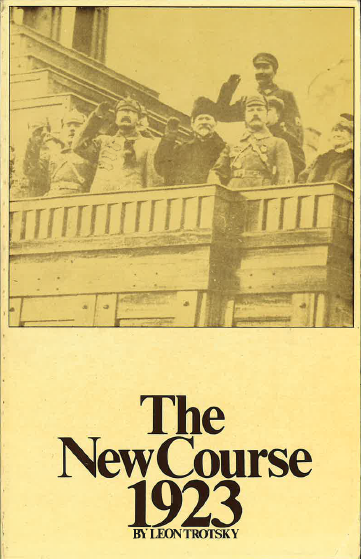
The New Course stands as one of the most important documents in the history of the Marxist movement, a work whose subject matter, the relationship between the revolutionary party and the working class, and between the party’s leadership and its membership, has lost none of its urgency in the century since it was written.
Written in late 1923, The New Course emerged directly out of the crisis of the Communist Party of the Soviet Union and the broader crisis of the Communist International following Lenin’s incapacitation and the consolidation of bureaucratic power under Stalin and the triumvirate of Zinoviev, Kamenev and Stalin. It was Trotsky’s opening shot in the Left Opposition’s political struggle, a struggle that would define the fate not only of the Soviet Union but for the socialist revolution internationally.
The work addresses, with a precision that remains striking, the problem of bureaucratic degeneration: how a revolutionary party, having seized power, can lose its connection to the living class struggle and become an instrument of conservatism and privilege rather than socialist transformation. Trotsky identifies the ossification of the party apparatus, the suppression of internal democracy, and the elevation of administrative routine over political thinking as the hallmarks of this degeneration. His insistence that the younger generation of the party must be educated not in passive absorption of handed-down directives but in the capacity for independent Marxist thought is a principle that applies to every revolutionary organisation in every period.
To study The New Course is to equip oneself with the political and theoretical tools necessary to understand both the betrayals of the 20th century and the tasks of socialist revolution in the 21st.
107 pages
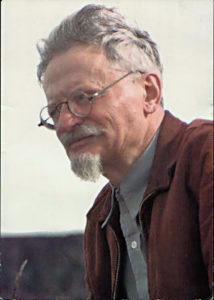 Leon Trotsky (1879-1940) was born on November 7, 1879 in the village of Yanovka, which at the time was part of the Russian Empire and is now within the borders of Ukraine. Along with Vladimir Lenin, he was one of the leaders of the October Revolution of 1917, which brought the Bolsheviks to power in Russia. Trotsky, who was head of the Red Army during the years immediately following the revolution, led the Soviet Union to victory in the Civil War from 1918-1921.
Trotsky founded the Left Opposition in 1923, which was established to oppose the growth of bureaucratism, nationalism, and inequality in the Soviet Union under Stalin’s leadership. He was an outspoken defender of the perspective of internationalism against the program of “socialism in one country”, which the Stalinist bureaucracy advanced as part of the defense of its own power and privileges.
Because of his intransigent opposition to Stalinism, he was expelled from the Communist Party in 1927, sent into exile in Central Asia in 1928, and ultimately banished from the Soviet Union in 1929. In 1933, Trotsky warned that the policies pursued by the Stalinist Communist Party in Germany, if not changed, would pave the way for the coming to power of Hitler by politically disorienting and organizationally disarming the working class in the face of the fascist threat. After his warnings were proven correct, Trotsky concluded that Stalin’s betrayal of the German working class meant that the Third International could not be reformed. In 1938, he founded the Fourth International. Trotsky was murdered in 1940 in Mexico, where he had been given asylum, by a Stalinist agent.
In addition to his political work, Trotsky was a major Marxist theoretician. He elaborated the theory of “permanent revolution”, which explained why an economically backward country like Russia was driven onto the path of socialist revolution despite the fact that it had a comparatively low level of capitalist development. Trotsky’s theory ultimately formed the basis for the October 1917 revolution.
His letters and articles explaining the class nature of the Soviet state, written in the context of an inner-party debate that took place in 1939-1940 within the Trotskyist movement and collected in the volume In Defense of Marxism, are a brilliant example of the application of the dialectical materialist method to the analysis of contemporary political questions and problems of party program and perspective.
Trotsky’s prediction, outlined most explicitly in The Revolution Betrayed, that unless the working class in the USSR regained power through a political revolution, the Stalinist bureaucracy would bring about the restoration of capitalism, was proven correct by the events of 1989-1991.
Additional information about Trotsky’s political biography, his role in Soviet and world history, and his treatment at the hands of modern historians can be found here: Leon Trotsky, Soviet Historiography, and the Fate of Classical Marxism
Books by Leon Trotsky