Lenin’s book The Development of Capitalism in Russia was the result of research lasting more than three years. Lenin began intensive work on his book when in prison, soon after his arrest in connection with the case of the St. Petersburg “League of Struggle for the Emancipation of the Working Class,” and finished it in the village of Shushenskoye where he lived in exile.
In his first letter from prison, dated January 2, 1896, Lenin wrote: “I have a plan that has occupied my mind considerably ever since I was arrested, increasingly so as time passes. I have long been engaged on an economic problem (that of the marketing of the products of manufacturing industry within the country), have selected some literature, drawn up a plan for its analysis and have even done some writing with a view to having my work published in book form, should its dimensions exceed those of a magazine article. I should be very unwilling to give up on the job, and am now, apparently, faced with the alternative of either writing it here or of abandoning it altogether.”
Lenin’s sister, A. I. Ulyanova-Elizarova, relates in her reminiscences that while Vladimir Ilyich was working on his book in prison “he decided to use the St. Petersburg libraries in order to obtain material needed for the work he had planned and that he knew he would not be able to get in exile. And so in prison he made an intense study of a mass of source material, and copied out numerous extracts. I dragged heaps of books to him from the Free Economic Society library, from the Academy of Sciences and from other scientific book reposititories.”
The draft of The Development of Capitalism in Russia was completed in August 1898 and came off the press at the end of March, 1899.
Pages: 696
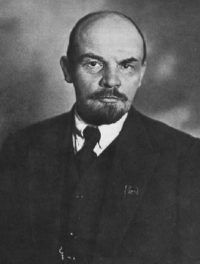 Vladimir Lenin (1870-1924) was the founder and leader of the Bolshevik Party and a central figure within the Marxist movement from the end of the 19th century until his death in 1924. In October 1917 he, along with Leon Trotsky, led the Russian Revolution that brought the Bolsheviks to power and established the first workers’ state.
In 1902 Lenin published What is to be Done?, a major theoretical work which critiqued the trade unionist perspective that sought to limit the struggles of workers to economic questions. He insisted on the necessity of a political solution to capitalist exploitation and outlined a theory of the revolutionary party as the vanguard of the working class.
Lenin led the split with the Mensheviks in the Russian Social Democratic Party in 1903, maintaining that the forthcoming revolution in Russia could not be of a solely bourgeois-democratic character. Over the course of the next 14 years he fought a long struggle against Menshevism. This ultimately culminated in his issuing in April 1917 of a set of political theses that unequivocally called for a proletarian socialist revolution in Russia.
Lenin was an ardent defender of internationalism. In 1914, when the German Social Democratic Party, the leading section of the Second International, abandoned Marxism by supporting German imperialism in World War I, Lenin fought against this national chauvinist perspective. In defense of the outlook of world revolution, he advocated the founding of the Third International. His Imperialism, published in 1917, identified the origins of the bloodbath engulfing Europe at the time in the inner workings of capitalism.
Lenin made major contributions to the development of Marxist philosophy, leaving behind a voluminous body of writings. Materialism and Empirio-Criticism was his defense of dialectical materialism and a withering critique of efforts by figures with ties to the Bolshevik Party to substitute idealist forms of thinking for materialist philosophy.
Lenin died in January 1924 after a series of strokes, which had left him incapacitated for many months prior. In his Last Testament, suppressed for many years by the rising Soviet bureaucracy, he called for the removal of Joseph Stalin from his post as General Secretary of the Communist Party of the Soviet Union.